In version 19.0 we have improved the possibility to configure the object designations in the system. You can now in detail control what designations are allowed for each level and designation structure.
For each level of the designation you can specify a mask that controls what is a permitted designation and what prefix is to be used before the level (or none). The mask is described with a simplified syntax A for letters and n for numbers. If needed, it is also possible to describe the allowed designation with a Regular Expressions.
Each level is also described with a prompt and a help text.
It is possible to have several different formats / prefixes at the same level but for different object categories.
The edit designation dialog is improved so that you can edit the complete designation and the program will automatically verify the designation and add prefixes if needed. You will also get sub-rows for the designation with one row for each level, with prompt and tooltip. When creating new object you will get one extra sub-row for the new object, but it is still possible to create many levels at one time if you have the complete designation by typing it in the designation row.
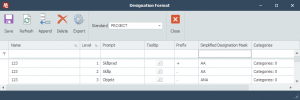
In the designation format dialog, you create the named designation formats. The named Designation formats is then used in the new designation configuration dialog to select what designation format to use in the different designation structures.
The settings are stored on the standard and are included in the export / import functionality. You can also export the settings so that you can edit the designations offline in elMaster Design and get the same visual result.
If not you will need to save/update the drawing to get the correct format of the designations on the drawing.

Language settings and AutoCAD
/0 Comments/in Support /by Johan DaleniusIt has been brought to our attention there is another problem with AutoCAD and Windows language settings. There is a new language setting in Windows and AutoCAD does not support having it activated.
Symptom
AutoCAD is unable to start. The following error message appears.
Exception in vl.crx ARX command
Solution
To solve this problem go to Windows settings for Region and Change system locale…
In the Region Settings dialogue you uncheck the option Beta: Use Unicode UTF-8 for worldwide language support.
Further reading
The vl.crx-problem is described in short above. In Autodesk Knowledgebase there is a full description.
Recently we wrote about AutoCAD crashing upon start with error “VLISP internal error: Unhandled exception on init”. Our solution was to rearrange the Windows language priority so that there no longer was a red warning icon showing. Autodesk posted a workaround to that problem. The same/similiar problem also have a another article in their knowledgebase with solution same as above.
In short you should be wary about changing language settings as it might break things.
HTTP-Activation
/0 Comments/in Support /by Johan DaleniusA recent Windows Update in regard to .Net have disabled a setting that used to be enabled per default and is required for the product suite to run properly. If you experience strange behavior probably already at initializing the product there is reason to suspect you might have received this update.
Solution is to reconfigure your system so that required feature is Enabled.
This setting must be enabled.
Note that up to date single license users do not need to rectify this as systems that have Internet Information Services (IIS) installed support HTTP-Activation even if the feature is disabled.
In case your version of Windows does not show this feature in the Windows-features dialogue one can use PowerShell to check if it is enabled with a command such as the following.
Named Pipe Activation
/0 Comments/in Support /by Johan DaleniusFew customers have come upon that a Windows setting that used to default active have been switched off in connection with patching .NET Framework 4.7 or installing Windows updates. Communication in between our applications use netpipe and as a result the product suite will not operate properly as the support is inactivated.
If you encounter behaviour out of the ordinary after uppdating your system make certain that .NET Framework > WCF Services > Named Pipe Activation is still checked, in other words activated.
Named Pipe Activation must be Enabled
Edit: Note that this screenshot is taken from a machine with IIS installed which is why HTTP-Activation is supported despite the .Net feature is not enabled.
Edit: Same applies if .Net Framework 4.8 is installed.
Designation Configuration
/0 Comments/in Product /by Christian UlltjärnIn version 19.0 it is possible to control in more detail which settings you want. Not just by standard and main folder, but also by structure and part of plant. The different settings format, category structure and letter codes have their own dialogs where you create the different configurations. In the new designation configuration dialog, you choose which configurations should apply to which structures.
Designation Format
/0 Comments/in Product /by Christian UlltjärnIn version 19.0 we have improved the possibility to configure the object designations in the system. You can now in detail control what designations are allowed for each level and designation structure.
For each level of the designation you can specify a mask that controls what is a permitted designation and what prefix is to be used before the level (or none). The mask is described with a simplified syntax A for letters and n for numbers. If needed, it is also possible to describe the allowed designation with a Regular Expressions.
Each level is also described with a prompt and a help text.
It is possible to have several different formats / prefixes at the same level but for different object categories.
The edit designation dialog is improved so that you can edit the complete designation and the program will automatically verify the designation and add prefixes if needed. You will also get sub-rows for the designation with one row for each level, with prompt and tooltip. When creating new object you will get one extra sub-row for the new object, but it is still possible to create many levels at one time if you have the complete designation by typing it in the designation row.
In the designation format dialog, you create the named designation formats. The named Designation formats is then used in the new designation configuration dialog to select what designation format to use in the different designation structures.
The settings are stored on the standard and are included in the export / import functionality. You can also export the settings so that you can edit the designations offline in elMaster Design and get the same visual result.
If not you will need to save/update the drawing to get the correct format of the designations on the drawing.
Category Structures
/0 Comments/in Product /by Christian UlltjärnIn Master Concept it is possible to specify how your plant should be structured.
In Category settings you can specify that a category is an End Category. That means that no objects are allowed under an object with a category that is specified as an End Category.
Form version 19.0 you can also create named category structures that can be used in different objects designation structures.
In the Category Structure dialog, you create the category structure trees and store them as a named category structure. In the new designation configuration dialog you can specify what category structure should be used for what designation structure. It is also possible to set if it is mandatory to follow the structure or if users should get a warning when trying to create something that does not comply with the specified category structure.
Letter Codes
/0 Comments/in Product /by Christian UlltjärnLetter codes are used to create new designations or set object categories for objects with a new designation. New for version 19.0 is that you can specify a filter for the upper designation that limits the number of proposed designations. There is also a new description field that is used if there is more than one available alternative when creating a new objects. The description text is also stored on the created objects Denom1 field.
In version 19.0 it is possible to create designations that are only numbers, [none] is used as letter code for that purpose. Designations without counter, with only letters is also possible to create if you set the length number part to 0.
Version 19.0 has been released
/0 Comments/in Product /by Kristian SjöströmKey Features
Egenskapkoppling Excel
/0 Comments/in Support /by Johan DaleniusSymtom
Problemet uppträder på så sätt att förväntade värden korrekt skrivs till Custom Properties i Excel men inte visas i namngivna celler.
Bakgrund
En komponent från tredje part som används vid egenskapskoppling mot Microsoft Excel har effektiviserats på ett för oss icke önskvärt sätt. När vi förväntar oss att få alla celler så hämtar komponenten endast celler som har innehåll. Mängden celler gås igenom och de vars namn matchar konfigurationen för egenskapskoppling får sitt värde uppdaterat. Tomma celler kommer alltså inte få värde även om de är namngivna och egenskapskopplingen korrekt konfigurerad.
Lösning
Från och med version 17.2.3 har förändring gjorts så att man inte behöver tillämpa workaround för problemet.
Behövs en lösning snarare än man har möjlighet att uppdatera kan problemet åtgärdas i mallen genom att ange ett värde i cellen. Vita tecken som tex mellanslag går bra om man vill undvika synlig text i cellen.
Exempel
Den namngivna cellen Dokumentnummer är i mallen en tom cell och förblir tom vid användning. För att cellen ska uppdateras med värde enligt egenskapskoppling behöver cellen ha innehåll. Skriver man ett mellanslag i cellen, sparar om mallen och försöker på nytt uppdateras cellen med aktuellt dokumentnummer.
Uppdatering: I och med förändringar som lanseras i 17.2.3 ställs inte längre något krav på mallen att cellerna behöver innehåll för att hämtas.
Hög processoranvändning för AutoCAD
/0 Comments/in Support /by Johan DaleniusOm man på en inaktiv AutoCAD ser att underprocesserna drar mycket processoranvändning är det ett varningstecken. Underprocesserna listas vid namn Chromium host executable eller AcWebBrowser.exe.
Aktivitetshanteraren för en frisk inaktiv AutoCAD
Har dessa underprocesser hög processoranvändning är det troligt att de kämpar med att komma åt online-innehåll. Det kan exempelvis vara online-hjälp, välkomst-meddelande, community eller molntjänster. Problemet kommer av att man å ena sidan försöker använda online-resurser i AutoCAD men samtidigt inte tillåter det. Åtgärdas genom att antingen i skyddsprogramvara tillåta dessa processer att kommunicera eller konfigurera AutoCAD så att man avstår online-material.
Skulle du ha problem med hög cpu rekommenderas länkad artikel i Autodesk Knowledge Base.